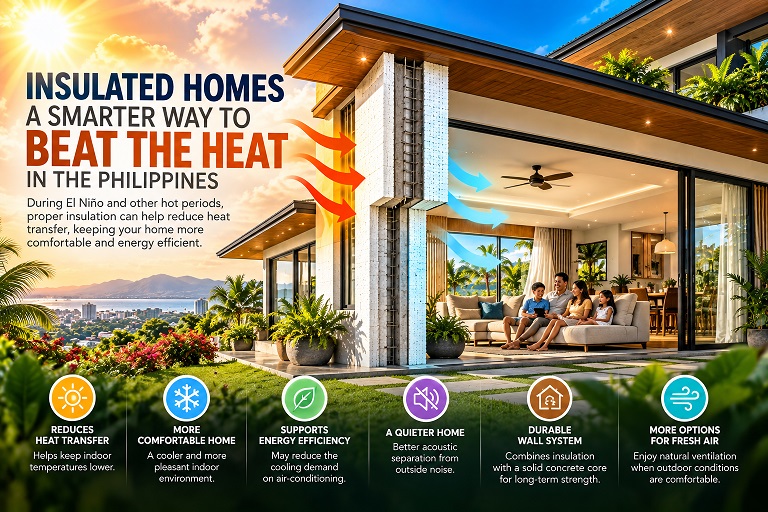
For many Filipino families, air-conditioning has become an almost unavoidable part of staying comfortable during the hottest months of the year. As temperatures rise, we close the windows, turn on the air-conditioner, and keep it running for hours at a time. But there is another way to think about keeping a home comfortable: instead of relying entirely on air-conditioning to fight the heat, why not design the house itself to resist heat entering in the first place?
This is where insulation becomes important.
The Philippines is a naturally hot and humid country, and periods of El Niño can make heat management even more challenging. DOST-PAGASA is currently reporting a strong to very strong El Niño in the tropical Pacific, with the phenomenon expected to continue into the first half of 2027. PAGASA also warns of warmer conditions and an increased likelihood of below-normal rainfall in many areas, although individual days can still bring rain and thunderstorms.
For homeowners, this raises a practical question: how can we make our houses more comfortable when the outside environment becomes hotter?
One answer is to improve the building envelope—the parts of the house that separate the indoor environment from the outdoors.
What Does Insulation Actually Do?
Insulation does not produce cold air. Instead, it slows the movement of heat through the walls, roof, and other parts of the building envelope. During a hot day, this can help reduce the amount of outdoor heat entering the house and can help the interior remain more thermally stable.
This is particularly relevant in the Philippines because the roof and exterior walls are constantly exposed to solar heat. A poorly insulated house can absorb substantial heat during the day, allowing interior surfaces to become hot and making the air-conditioner work harder to maintain the desired temperature.
A properly designed insulated house approaches the problem differently. Rather than depending entirely on mechanical cooling, the building envelope itself becomes part of the home’s defense against heat.
Why Consider ICF?
One insulation technology that has attracted attention in residential construction is ICF, or Insulated Concrete Forms.
ICF construction uses insulated forms that remain as part of the wall system while concrete is placed inside them. The result is a substantial wall assembly that combines insulation with a concrete structural core.
The exact performance of an ICF house depends on its complete design, engineering, workmanship, windows, roof, shading, ventilation, and other components. However, one of the major reasons people consider ICF is its ability to reduce heat transfer through exterior walls while also providing a solid and durable wall system.
ICF is not the only way to insulate a home. Prefabricated insulated wall systems, insulated concrete systems, properly designed cavity walls, insulated roof assemblies, and other building methods can also provide thermal benefits. The important question is not simply which material is being used, but whether the entire house has been designed to manage heat effectively.
Insulation Can Help Reduce Cooling Demand
One of the biggest potential benefits of a better-insulated home is that the air-conditioner may not have to work as hard to overcome heat entering through the building envelope.
This does not mean an insulated house will never need air-conditioning. The Philippine climate is hot and humid, and air-conditioning can still be important for both temperature control and humidity management. Actual electricity savings also depend on many factors, including the size and orientation of the house, windows, roof insulation, shading, air leakage, thermostat settings, equipment efficiency, occupancy, and how long the system operates.
But reducing unwanted heat gain can make the job of mechanical cooling easier.
Think of it this way: an air-conditioner removes heat from inside the house. Insulation helps slow down the rate at which heat enters the house. When both work together, the overall cooling strategy can become more efficient.
The Roof Is Just as Important
When discussing insulated homes, people often focus on the walls and forget about the roof.
That can be a mistake.
A Philippine roof can receive intense solar radiation throughout the day. Without adequate insulation and proper roof design, significant heat can be transferred into the spaces below.
For this reason, a high-performance tropical home should consider the entire building envelope—not just the wall material. Roof insulation, reflective or appropriate roofing materials, ventilation strategies, ceiling design, exterior shading, windows, and wall insulation can all contribute to better thermal performance.
Windows Matter Too
Even the best insulated walls cannot compensate for poorly designed windows.
Large areas of glass can allow considerable solar heat into a home, particularly when windows face strong afternoon sun. Solar-control glass, appropriate window sizes, external shading, roof overhangs, awnings, curtains, blinds, and thoughtful building orientation can all help control solar heat gain.
At the same time, windows provide something insulation cannot: natural ventilation and daylight.
When outdoor conditions are comfortable, opening appropriately positioned windows can allow fresh outdoor air and natural breezes to move through the house. Cross-ventilation can be particularly useful in tropical residential design.
Of course, opening windows is not appropriate under every condition. Heat, humidity, outdoor air quality, rain, insects, noise, and security all need to be considered. Good tropical design is about having choices rather than depending on a single strategy.
A Better Way to Think About Comfort
The goal of an insulated home should not be to eliminate air-conditioning. The goal is to reduce unnecessary heat gain and give the occupants more control over their indoor environment.
On extremely hot afternoons, you may still want the air-conditioner.
During cooler mornings, evenings, cloudy periods, or days when outdoor conditions are comfortable, you may be able to rely more on natural ventilation.
That flexibility can be valuable.
Instead of designing a house that assumes the air-conditioner will always be running, homeowners can design a house where insulation, shading, ventilation, windows, landscaping, roof design, and efficient cooling equipment all work together.
Why This Matters Beyond El Niño
El Niño will eventually weaken. But the need for comfortable homes in a hot tropical climate will remain.
That is why insulation should not be viewed simply as an “El Niño feature.” It is better understood as part of a long-term approach to residential design.
A well-designed insulated home can potentially provide better thermal stability, reduce unwanted heat transfer, improve indoor comfort, and reduce dependence on mechanical cooling under suitable conditions. Depending on the wall system, insulation can also contribute to acoustic comfort and create a more solid feeling within the home.
The most effective approach is usually not one technology by itself. It is a combination of good architectural design, appropriate insulation, effective shading, suitable windows, roof protection, natural ventilation, efficient air-conditioning, and proper construction.
Is an Insulated Home Right for You?
If you are building a new house, this is the best time to ask questions about insulation.
Ask your architect or contractor how much heat the walls and roof are expected to absorb. Ask what type of insulation is being proposed, where it will be installed, how windows will be protected from direct solar heat, and how natural ventilation will work.
Ask whether the design considers the orientation of the house, prevailing winds, roof exposure, afternoon sun, air leakage, and the actual climate where the property will be built.
And most importantly, look at the house as a complete system.
A comfortable tropical home is not created by one material alone.
ICF can be part of that solution. Other insulated wall systems can also be appropriate. What matters is selecting a system that matches the structural requirements, budget, architectural design, local climate, construction quality, and long-term goals of the homeowner.
As El Niño reminds us, the climate can place significant demands on our homes. Designing the house to deal with heat before the air-conditioner has to deal with it can be a smart long-term investment in comfort.
The future of comfortable Philippine housing may not simply be about installing bigger air-conditioners.
It may be about building homes that are better prepared for the heat in the first place.
Leave a Reply